💡 Note: This guide is part of our digital growth education series. We update it periodically as new insights and tools emerge.
Introduction
Imagine a small bakery in your neighborhood. The owner spent money on online ads, hoping customers would come. The ads got clicks — but very few purchases.
She wondered: “Why am I spending money online and barely making sales?”
Meanwhile, a friend running a similar business took a different approach. Instead of only paying for ads, he set up a simple website where people could order, offered a way to join his email list for discounts, and shared useful tips about his products.
Within months, he had a growing list of customers he could reach directly — and sales started coming in steadily, without wasting money on random ads.
The truth is simple: growing a business online isn’t about luck or viral posts. It’s about building a clear system that brings people in, captures interest, and turns them into customers.
Even if small campaigns bring results, they rarely reveal the full potential your business could achieve with a proper system.
This guide focuses on the strategy and framework required for growth of your business. If you are looking for the detailed technical setup — like installing analytics, hosting, or verifying your business online, check out our separate technical checklist. TECHNICAL SETUP GUIDE
Why Random Tactics Fail (The Chaos vs. System Problem)
Most businesses face digital marketing chaos: hopping between platforms, running random ads, and hoping traffic turns into sales.
This lack of a central plan leads to scattered data, wasted time, and inconsistent results.
What Does It Mean to Grow a Business Online?
Growing a business online isn’t just about posting on social media or having website alone. Digital growth for businesses is about building a system that brings people in, keeps their attention, and turns them into paying customers.
Think of it like this: if 100 people walk past a shop, not all come inside. But if the shop has a clear sign, a friendly helper, and a small offer that captures contact info, some passersby become customers. Online, the same principle applies — a system works whether people find you via Google, social media, or shared links.
There are three main parts to this system:
- Visibility – Being easy to find when someone is looking for what you offer.
- Lead Capture – Turning visitors into contacts, like emails or phone numbers.
- Predictable Revenue – Knowing how many visitors will become paying customers.
In short: online growth is about building a predictable process that keeps working, instead of hoping a random post or viral moment will bring sales.
Why Growing Your Business Online Matters in 2026
Whether you are seeking to grow a business online from scratch or scale an existing enterprise, establishing digital assets is no longer optional — it is a competitive necessity.
Let’s put this in context with relatable stories:
Small Tutoring Business
A friend ran a small tutoring service. He relied on parents calling after seeing flyers. Growth was slow and unpredictable. Then he built a simple website, offered a “5-Day Study Guide” students could download in exchange for their email, and shared helpful tips online. Suddenly, he had a list of interested parents he could reach directly — and students started signing up consistently.
Big Company Example – Netflix
A few years back, Netflix moved away from DVD rentals to focus fully on streaming. They built an easy-to-use platform, suggested content based on user preferences, and made it simple to watch anywhere. Within a few years, they grew from a niche business to a global leader — not because of luck, but because of a reliable digital system.
Another Familiar Example – Domino’s Pizza
Around 2008, Domino’s noticed their online ordering system was clunky, and customers complained. They revamped the website and app, made it easy to customize and order pizzas online, and added delivery tracking. Sales went up dramatically because customers could now order anytime, anywhere, making the business more predictable and scalable.
Key Takeaways
- Global Search – Over 80% of people check online before buying anything, even locally.
- Always Open – Your website works 24/7, giving information and capturing interest while you sleep.
- Reach Beyond Borders – A business in Lagos can serve customers in London or Los Angeles, instantly expanding potential income.
Even a small effort online can produce a far better return than expensive flyers, radio ads, or random social media posts. If you’re not building these digital systems, your competitors almost certainly are.
The Complete 5-Phase Roadmap for Digital Business Growth
With the story context in mind, here’s the step-by-step roadmap for digital business growth. Each phase builds on the previous, creating a predictable, repeatable system:
| Phase | Goal |
|---|---|
| Phase 1: Foundation | Build your infrastructure: Website, Analytics, Lead Capture System (the centerpiece) |
| Phase 2: Traffic | Drive traffic and attract visitors: SEO, Content Marketing, Social Media, etc. |
| Phase 3: Conversion | Converting visitors into Lead: CRO, Funnel Optimization, etc. |
| Phase 4: Optimization | Improved KPIs and system efficiency: KPI Tracking, A/B Testing, etc. |
| Phase 5: Scale | Automate and expanding proven and predictable systems: SOPs, Automation, etc. |
Phase 1 — Building Your Digital Foundation
Before worrying about traffic, you need a digital foundation that can receive and capture visitors. Think of it like opening a physical store: no matter how many people walk by, if your shop is dark, messy, or has no staff, sales won’t happen. Online, your foundation is what makes small business growth possible.
Step 1 — Create a Professional Website
Your website is your central hub for establishing digital assets. Business owners often wonder if social media is enough. The short answer: no. Social media platforms can change rules, limit visibility, or even suspend accounts. Your website? That’s your owned digital asset—the one you fully control.
- Budget Context: Use free/low-cost CMS like WordPress, Wix, or Squarespace.
- Coding Note: Beginners without technical knowledge can avoid coding by using CMS (Content Management Systems) platforms.
- Essential Components for online business growth: Fast, secure, mobile-friendly, clear navigation. Easy integration with email, analytics, and Google Business Profile.
Relatable Scenario: A local bakery with a website that shows menus, ordering options, and a clear signup for discounts converts more visitors into paying customers than relying solely on social media posts.
Gives you more time to attend to other things than having every time conversations with customers.
If you're looking for a complete guide to setting up your website with either CMS or coding, we’re preparing a dedicated article that will be linked here — WEBSITE SETUP ARTICLE - Coming soon
Step 2 — Set Up Google Business Profile (GBP)
For local digital business growth, your Google Business Profile (GBP) is a critical source of high-intent, free traffic.
- Local Visibility: GBP determines your position in Google Search & Maps online.
- Optimization Tips: Claim & verify, use accurate categories/photos, include local keywords, get positive reviews.
Reviews Matter:
Consistently acquiring positive reviews increases trust and visibility. A business with 50 positive reviews will almost always outrank a competitor with only 5.
Relatable Scenario: Imagine a traveler visiting your city who wants to buy clothes or shoes. They might ask locals, which isn’t always reliable, or check online.
It is recorded that Millions of people make searches like: “shoe seller near me” or “cloth shop [city name]”. Google mostly shows results from businesses near their search location, relying heavily on GBP listings. A properly optimized GBP can bring in new customers who may become loyal if you offer excellent service or products which can help gain more reviews and be the top seller in the area.
If you’re looking for a complete guide to setting up your GBP, we’re preparing a dedicated article that will be linked here — GBP SETUP ARTICLE - Coming soon
Step 3 — Install Basic Analytics Tracking
You cannot measure what you cannot track. Analytics sounds technical, but you only need to understand a few key numbers and implementations to guide your decision-making.
- Must-Have Free Tools: Google Analytics 4 (GA4), Google Search Console (GSC).
- Integration: Connect both to your website to track visitor behavior and acquisition channels.
- Conversion Events: Define actions like form submission or purchases for actionable insights.
A very Crucial Setup is : Defining a conversion event in GA4.This is a specific action you want people to take (e.g., submitting a contact form, making a purchase, or downloading a guide). Without this, you are flying blind.
Example: A small yoga studio learned that Instagram drove 70% of new leads after setting up GA4. Focusing there doubled class sign-ups without extra ad spend.
Do you see why this is important? You now know where to invest time and effort instead of randomly trying tactics and hoping one works.
If you're looking for a complete guide on instaling and integrating GA4 and GSC, we’re preparing a dedicated article that will be linked here — INSTALLING BASIC ANALYTICS ARTICLE - Coming soon
Step 4 — Set Up Lead Capture System (THE CENTERPIECE)
Without lead capture, every visitor who leaves your site is probably gone forever. This is the most critical step for growing a business online. With a high-value lead capture system, you build an owned asset: your email list.
Key Components:
- Lead Magnet: Solve a small, painful problem. Examples:
- Low Value: “Sign up for newsletter”
- High Value: “7-Point Checklist: Audit Your Website SEO in Under 1 Hour”
- Email Service Platform (ESP): MailerLite, Mailchimp, Brevo/Sendinblue.
- Multiple Capture Points: Hero section, blog posts, exit popups.
- Success Metric: Aim for 2–5% of website visitors to convert into subscribers.
If you're looking for a complete guide to setting up your Lead Capture System, we’re preparing a dedicated article that will be linked here — LEAD CAPTURE SYSTEM SETUP ARTICLE - Coming soon
Step 5 — Connect Your Digital Assets
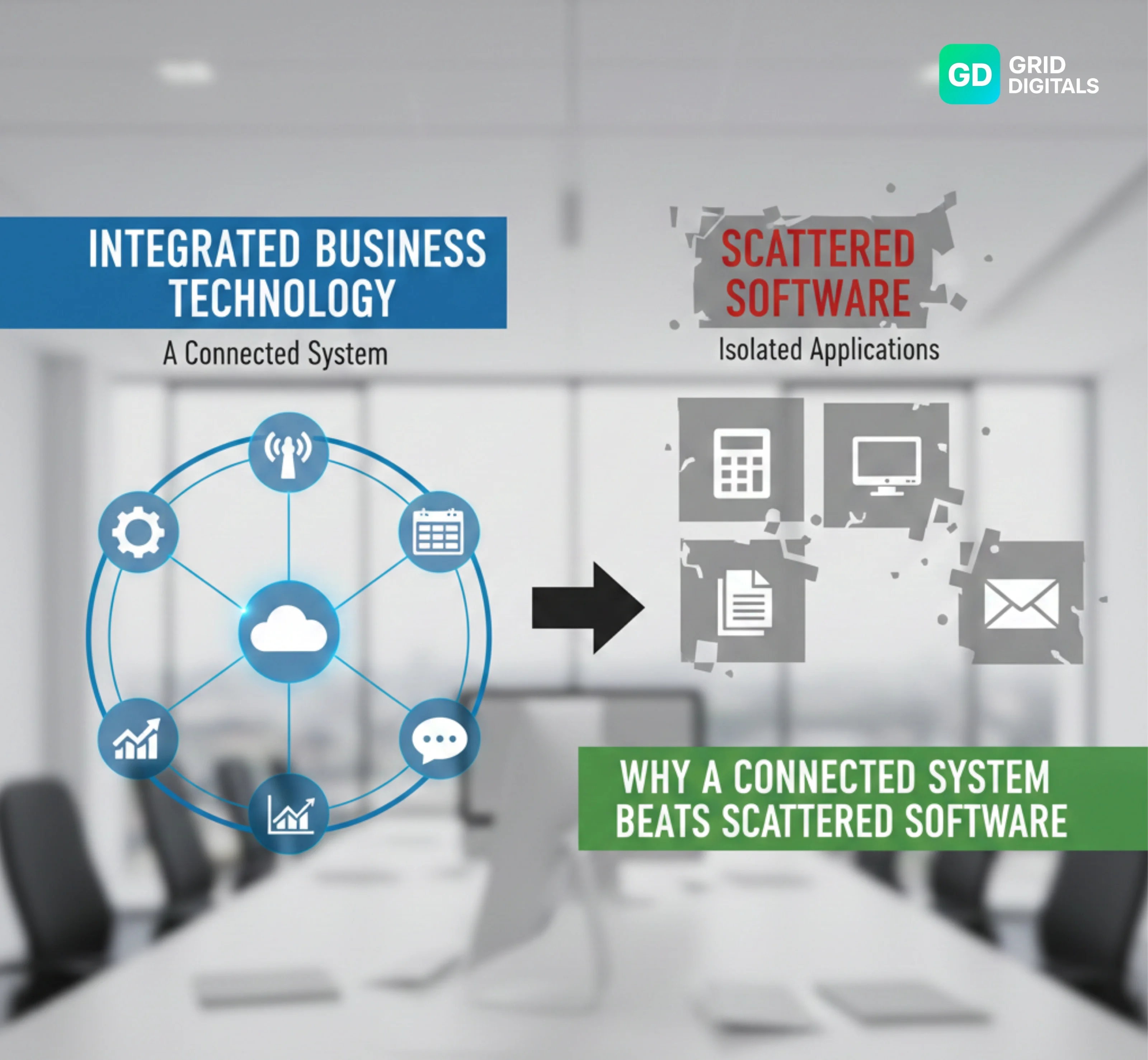
Your separate digital assets must function as a single interconnected system. This is the online business growth roadmap in practice:
- Ensure your website links to your Google Business Profile (GBP).
- Link your social media profiles to the landing page for your Lead Magnet.
- Every piece of content created in Phase 2 must direct users back to your Phase 1 Lead Capture System
Why This Is Crucial: A connected system ensures that traffic, engagement, and leads are captured efficiently. Scattered or disconnected assets waste opportunities, as visitors leave without entering your ecosystem.
Example: A while ago, I worked with a small online fashion brand as a strategist. I was brought in because their growth had stalled.
When I reviewed their setup, nothing was broken. Their Instagram, blog, Google Business Profile, and ads were all active — but none of it was connected. People would see a post, read an article, or click an ad, and then disappear.
I advised them to link everything into one clear path, pointing all channels to a single landing page with a free Style Guide for Busy Professionals. After that, visitors stayed longer, more people joined the email list, and past customers returned. Ads worked better because traffic no longer ended after one click.
Nothing new was added. The system was just finally connected
Foundation Phase Checklist
- ✅ Professional website live
- ✅ Google Business Profile claimed & optimized
- ✅ GA4 & GSC installed with conversions tracked
- ✅ High-value Lead Magnet active on 3 key pages
- ✅ Email welcome sequence written
- ✅ All assets interconnected and tested
Phase 2 — Attracting Traffic & Building Visibility
With your Lead Capture System ready, it’s time to drive traffic to it. This phase focuses on the most effective, scalable strategies for online visibility and getting customers online for free.
Strategy 1 — SEO (Search Engine Optimization)
SEO is the engine of sustainable, high-quality free traffic. It’s the process of structuring your website and content so your business appears when people search online.
Time Factor: SEO is a long-term play, typically taking 3–6 months for meaningful results. This traffic is free, targeted, and compounds over time.
- Optimize website for speed, mobile, clear navigation, descriptive titles & meta. SEO Advice:
- Target long-tail keywords for high-intent traffic.
Content Focus: Target long-tail keywords—specific search phrases like: “best accounting software for freelance artists”. They signal high intent, are easier to rank for, and attract better-qualified leads.
Example: Imagine you run a small clothing shop and decide to start a blog so people can find you online. Instead of trying to rank for a big, crowded keyword like: “buy clothes online” (millions of competitors) …you focus on a long-tail keyword like: “affordable native wear for men in Aba”.
So when you write a simple article like:
“Best Affordable Native Wear for Men in Aba (2026 Buying Guide)”
Google can easily understand who should see your content, and you start showing up faster because:
- There’s less competition
- Your content is extremely relevant and intentional
- Searchers feel like you’re speaking directly to them
This is why long-tail keywords help beginners grow a business online faster — they give you early visibility, targeted traffic, and customers who already know what they want.
If you're looking for a complete guide to setting up SEO fully, we’re preparing a dedicated article that will be linked here — SEO SETUP ARTICLE - Coming soon
Strategy 2 — Content Marketing
Content builds authority, educates your audience, and supports SEO: blogs, guides, videos, case studies, and infographics.
The most effective content strategy for growing a business online is the Topical Cluster model.
- Pillar Content: One comprehensive, high-level guide (like this one) that covers a topic in depth.
- Cluster Content: Shorter subtopic articles that focus on specific questions and link back to the pillar.
- The Link Back: Every cluster post funnels users toward your Lead Magnet, establishing authority and turning visitors into subscribers.
Example:
Imagine a small skincare brand that just opened in a busy neighborhood. They don’t have money for ads, so they use content marketing to drive free customers online.
They create one main guide: “Complete Beginner’s Skincare Routine for Oily Skin (2026 Guide)” — this is the pillar content.
Then they publish smaller related articles:
- “How to Choose the Right Cleanser for Oily Skin”
- “5 Home Remedies That Actually Work for Acne”
- “Morning vs Night Routine: What Matters More?”
Each of these shorter articles links back to the main guide. Inside the main guide, there’s a free Lead Magnet: “Download Your Free 7-Day Clear Skin Starter Routine.”
Why this worked:
- The content answered real questions people were searching for
- Google recognized the topical cluster and ranked the pages faster
- Readers stayed longer because the content solved real problems
- Every article pushed visitors toward the free routine
- The free routine built trust, leading to subscriptions
Results after 6 weeks:
Blog traffic grew from 0 to 1,200 visitors/month
530 people downloaded the 7-day routine
70 customers bought the “Starter Skincare Bundle” after receiving the follow-up email sequence
The big result came because the content pieces were connected like a system, not published randomly.
Strategy 3 — Social Media (Smart Approach)
Social media is a traffic source, not your main business platform.
Choose 1–3 platforms based on where your audience spends the most time:
- LinkedIn: B2B businesses
- Instagram / TikTok: B2C and visual products
Strategic Direction: Every post, story, or video should include a clear Call-to-Action (CTA) that directs users to your website or Lead Capture System.
Example:
A young fashion designer posted outfit videos on TikTok and Instagram. Before this, her posts had no direction — no link, no CTA, no system.
She changed her approach:
- One clear CTA on every post:
“Download my free ‘5 Outfit Formulas You Can Wear Anywhere’ — link in bio.” - Focused on ONE platform: She chose TikTok and committed to it for 30 days.
- Each video solved ONE micro-problem: Styling baggy jeans, dressing expensive on a budget, color combinations that always work.
- Traffic moved OFF social → INTO her system
These videos were short, helpful, and naturally made people want more.
Results after 30 days:
Three videos went mildly viral (not crazy viral, just 20k–40k views each)
480 people downloaded the outfit guide
58 people bought the digital product “The Capsule Wardrobe Starter Pack”
Why it worked:
- Social media was not treated as her “home”
- Every post had ONE job — send traffic to the system
- Small, specific problems created high engagement
- Email nurtured visitors into customers
The system created momentum because social media wasn’t the business — it was the traffic pipeline.
Strategy 4 — Email Marketing
Phase 2 is about actively nurturing the list you built in Phase 1.
The Nurture Sequence:
- 3–7 automated emails
- High-value tips, stories, and actionable advice
- Build authority before asking for a sale
ROI Insight: Email marketing delivers the highest return on investment globally — approximately $40 for every $1 spent. Maintain a 90% value / 10% promotion ratio.
Example: A bakery sent weekly “Baking Tips & Discounts.” After 6 weeks, 20% of the email list purchased, boosting repeat sales without additional ad spend.
Strategy 5 — Paid Advertising
Paid ads can quickly generate traffic — but only if your system is already proven.
The Warning: Never start ads without a working Lead Capture System. Otherwise, you waste money on unqualified traffic that never converts.
The Crucial Test:
- Ads should go to a single, focused landing page
- Test specific offers or audiences first, then scale
Example:
A home tutoring service wanted more students. But instead of rushing into ads, they first completed their Phase 1 foundation.
They built a simple landing page with one clear purpose: get parents to download a free “5-Day Study Improvement Plan.”
That free plan was connected to an automated email sequence that delivered:
- Study tips parents could apply immediately
- Sample practice questions for students
- A soft offer for a discounted first tutoring session
Only after this system proved it could turn visitors into leads did they begin testing paid ads.
Step 1 — One small ad test:
They created a Facebook ad targeting parents in their city. The ad didn’t sell tutoring directly. It promoted only the free study plan.
Simple headline:
“Want your child to study better in 5 days? Get the free guide.”
Step 2 — Traffic sent ONLY to the landing page:
- No distractions
- One benefit-driven headline
- A short preview of the study guide
- One CTA button: “Get Instant Access”
Step 3 — The connected system did the heavy lifting:
The ads brought in parents. The landing page converted them into leads. The email sequence built trust. Then the offer was introduced naturally.
🔥 Results after 14 days:
620 parents downloaded the free study plan
74 booked a trial tutoring session
27 became paying clients
The ads didn’t succeed on their own. The system succeeded because everything was already connected and optimized before any money was spent.
This is exactly how paid advertising should be used: not as a rescue plan, but as a scaling tool for a system that already works.
Phase 2 Takeaways
- ✅ SEO & content build long-term, compounding traffic
- ✅ Social media drives traffic to owned assets
- ✅ Email nurtures leads into repeat customers
- ✅ Paid ads scale a proven system, not replace it
Phase 3 — Conversion and Lead Capture Mastery
Traffic is expensive — either in time (SEO) or money (paid ads). This phase focuses on reducing waste and maximizing the return on every single visitor.
Conversion Rate Optimization (CRO) Basics
Conversion Rate Optimization (CRO) is the systematic process of increasing the percentage of website visitors who take a desired action — such as signing up for your lead magnet, booking a call, or requesting a quote.
- Reduce Friction: Every extra step a user has to take reduces conversion rates. Keep forms short — name and email are often enough. Make your CTA button stand out clearly by using strong contrast against the page background.
- Build Trust: Include clear testimonials, security badges, and a transparent privacy policy near all conversion points. Visitors convert faster when they trust your site.
- A/B Testing: This is the scientific method of digital growth. Test small changes in isolation — headlines, images, button text, or layout — then use real data to refine your conversion rate continuously.
Example:
A small online store tested two CTA buttons: “Download Now” versus “Get Your Free Guide.”
The “Get Your Free Guide” button increased conversions by 35%, proving that even subtle wording changes can have a major impact.
The Structure of a High-Converting Lead Magnet
Your lead magnet is your pre-sale. It showcases your expertise by giving away your best advice on one tiny, specific problem.
| Low Value (Avoid) | High Value (Aim For) |
|---|---|
| Sign up for our monthly newsletter | The Single-Page Template for B2B Consultants to 10X Their LinkedIn Views |
| Contact us for a free consultation | The 7-Point Checklist: Audit Your HVAC or Plumbing Business Website SEO in Under 1 Hour |
| — | The Ultimate Guide to Setting Up an Online Shop for a Clothing or Apparel Business |
| — | Free PDF: 10 Steps to Get More Local Clients for Your Landscaping or Cleaning Business |
Real-World Example:
An e-commerce business selling specialized accessories struggled to grow until they replaced a generic “20% off” offer with a downloadable “Ultimate Buying Guide: How to Avoid Counterfeit Accessories.”
- Sign-ups tripled
- Visitors felt instant trust in the brand
- Leads were more engaged and primed for future offers
Key Takeaway: Specific, actionable lead magnets convert far better than generic offers because they solve a tangible problem immediately.
Phase 3 Takeaways
- ✅CRO ensures you maximize value from every visitor
- ✅Lead magnets should solve a specific, actionable problem
- ✅The first 48 hours after signup are critical for trust-building
- ✅ A thoughtful welcome sequence compounds the value of Phases 1 and 2, turning leads into predictable revenue
We’ll see in the final story how small tweaks to lead magnets and welcome emails completely transformed the conversion rate for a local shop — let’s keep going.
Phase 4 — Optimization and Measurement
Growth is not linear. This phase ensures your system runs at peak efficiency, turning traffic and leads from Phases 2 and 3 into predictable, scalable revenue.
The 5 Key Metrics Small Businesses Must Track (KPIs)
Forget vanity metrics like likes or shares. Focus on KPIs that directly impact revenue and decision-making.
| KPI | What It Measures | Why It Matters |
|---|---|---|
| Cost Per Lead (CPL) | Total ad spend ÷ total leads generated | Shows how much each potential customer costs |
| Conversion Rate (CR) | Total leads ÷ total visitors | Indicates how effective your website and lead magnets are |
| Customer Acquisition Cost (CAC) | Total marketing + sales spend ÷ new customers | Must stay lower than Customer Lifetime Value to remain profitable |
| Customer Lifetime Value (CLV) | Average purchase value × purchase frequency × customer lifespan | Reveals the long-term value of each customer |
| Return On Ad Spend (ROAS) | Total revenue from ads ÷ total ad spend | Identifies which campaigns are truly profitable |
Example:
A local landscaping business tracked these KPIs and discovered that while Facebook Ads generated many leads, their CAC was too high. By improving their website funnel and email nurture sequence, they reduced CAC by 40% — increasing profit without increasing ad spend.
Finding and Fixing Conversion Leaks (Using Free Tools)
Conversion leaks are points where potential customers drop off unnecessarily. Fixing these leaks often increases revenue without adding more traffic.
- Google Analytics: Identify pages with high exit rates. If users consistently leave a pricing page, the offer, layout, or CTA may be unclear.
- The Rule of 3: If a visitor clicks more than three times from the homepage to your main conversion goal, simplify the journey. Shorter paths convert better.
- Free Heatmaps (e.g., Microsoft Clarity): Visualize where users click, scroll, or hesitate. Heatmaps expose confusing layouts, broken buttons, and ignored content.
Example:
A small online fashion brand noticed many users dropped off during checkout. Heatmaps revealed confusing shipping options. After simplifying choices and adding a clear progress bar, checkout completions increased by 28% in one month.
Key Takeaways for Phase 4
- ✅Track KPIs that directly affect revenue, not vanity metrics
- ✅Identify and fix conversion leaks using free tools
- ✅Small design, copy, or layout changes often create outsized gains
- ✅ Optimization ensures all previous efforts (traffic + lead capture) deliver maximum returns
Phase 5 — Systems, Automation, and Scaling (How to Scale Your Business Online)
This phase transforms your digital strategy from a time-intensive project into a predictable, semi-passive system that continues generating revenue while you focus on growth and strategy.
Introduction to Marketing Automation (Saving Time)
Marketing automation executes repetitive tasks without manual effort, allowing you to focus on high-leverage work instead of daily operations.
- Automatically sending your welcome email sequence after someone signs up (from Phase 3)
- Scheduling social media posts across platforms
- Tracking leads through your funnel using CRM software
Example:
A SaaS startup automated trial sign-up emails and follow-ups. Within two months, engagement improved and 20% more trials converted into paying customers — without adding manual work.
Building Systems: Documenting Your Success
If a process exists only in your head, it cannot be scaled. Documented systems ensure consistency, quality, and repeatability.
Standard Operating Procedures (SOPs) are step-by-step instructions for repeatable tasks, such as:
- How to publish a blog post
- How to onboard a new client
- How to run a Facebook Ads campaign
The Freedom Principle: SOPs allow delegation without sacrificing quality. Once documented, someone else can execute the task while you focus on strategic growth.
Example:
A boutique marketing agency documented its content creation workflow. After a freelancer followed the SOP, content quality stayed consistent, engagement increased, and the founder regained 10 hours per week.
Key Takeaways for Phase 5
- ✅ Automation frees your time while keeping lead nurturing and sales consistent
- ✅ SOPs create repeatable, scalable systems without sacrificing quality
- ✅ Data-driven hiring and outsourcing maximize ROI and protect your focus
- ✅ When combined with Phases 1–4, your business becomes a predictable, scalable growth machine
Your Action Plan: Getting Started Today
Strategy without execution changes nothing. This action plan turns the 5-phase roadmap into clear, achievable milestones so you always know what to focus on next.
| Timeline | Action Checklist | Lead Capture Milestone |
|---|---|---|
| This Week |
| Define your Lead Magnet idea |
| Month 1 Goals |
| Lead capture forms live on at least 3 key pages |
| Month 3 Goals |
| Convert at least 1% of visitors into leads |
| Month 6 Goals |
| Convert 3% of visitors into leads |
Real-World, Results-Driven Example: The Coordinated System in Action
Before we wrap up, I promised to share a real story from my work as a consultant. I’ll keep this sharp, practical, and honest — you’ve already absorbed a lot in this guide, and this is the reward for making it to the end.
A few years ago, a small clothing and accessories shop reached out to me. They relied mostly on foot traffic in their neighborhood and had a Facebook page with very low engagement. Sales were inconsistent, and they wanted to grow online without wasting money on random ads.
✅Phase 1 — Foundation First (Months 1–3)
We started exactly where every sustainable online business should: the foundation. A simple, mobile-friendly WordPress website was built to clearly showcase their products. We set up and optimized their Google Business Profile so local shoppers could find them easily, complete with photos, correct categories, and location-based keywords.
Next came the Lead Capture System. We created a high-value lead magnet: “Top 10 Wardrobe Essentials for Professionals.” Signup forms were placed strategically across the website.
Within three months — before running ads or doing heavy promotion — they had 600 email subscribers and new local customers who had never physically visited the store. This was the first proof that owning digital assets changes everything.
✅Phase 2 & Phase 3 — Traffic and Conversion (Months 4–9)
With the foundation in place, we focused on attracting the right people and converting them efficiently. The website was optimized for long-tail keywords like “affordable professional clothes Lagos”. Helpful blog posts such as “5 Must-Have Work Outfits for Women” were published and linked directly to the lead magnet.
On Instagram and TikTok, the brand shared styling tips and product demos, always directing followers back to the free guide. Paid ads were used sparingly — only to test offers, not to force sales.
Within six months:
- Monthly traffic grew to 1,200 visitors
- The email list reached 2,500 subscribers
- Social media contributed nearly one-third of all new leads
As traffic increased, conversion became the priority. The lead magnet was refined to solve a more specific problem instead of offering generic discounts — sign-ups instantly tripled. CTA buttons were A/B tested for wording, color, and placement. A structured welcome email sequence delivered value and built trust within the first 48 hours.
The result was powerful: from 2,500 subscribers, 450 became paying customers in just three months, without increasing ad spend.
✅Phase 4 & Phase 5 — Optimization and Scaling (Months 9–12)
At this stage, everything was measured. We tracked conversion rates, customer acquisition costs, and email-driven revenue. Pages with high exit rates were redesigned — simplifying layouts and clarifying calls to action. Small changes doubled the effectiveness of their existing traffic.
Then we scaled with systems. Marketing automation handled welcome emails, abandoned cart reminders, and nurture campaigns. SOPs were written for content creation, social posting, and customer follow-ups, allowing the owner to delegate without losing quality. Lead scoring ensured the most engaged subscribers received priority offers.
Within one year:
- Monthly revenue grew from $3,500 to $15,000
- Traffic conversion stabilized at 5–7%
- Paid ads returned $12 for every $1 spent
By the end of the journey, the business had a predictable, scalable online system. Their email list exceeded 10,000 subscribers, organic traffic reached 3,500+ visitors per month, and sales became consistent — not lucky.
This is what happens when Phases 1–5 work together. Traffic, content, and lead capture compound over time.
Final Guidance on Execution
Whether you implement this roadmap yourself, hire a freelancer, or work with an agency, structured execution matters more than effort.
Many businesses fail not because the strategy is wrong, but because execution is scattered. If SEO keywords don’t match your Lead Capture page, or traffic sources don’t connect to your funnel, the system breaks — and it looks like growth “doesn’t work.”
The key is methodology. Ensure whoever executes this roadmap follows a connected, coordinated process where every task feeds the same system.
Conclusion
Growing a business online is not magic or viral luck. It is the result of building digital assets, capturing traffic, and optimizing each step deliberately.
The 5-Phase Roadmap replaces random tactics with a defensible, predictable growth system. The biggest mistake is getting traffic without capturing it. Set up your Lead Capture System from Day 1.
Online success belongs to businesses with coordinated systems and consistent execution. You now know how to grow a business online. The only question left is: will you start today?
FAQs — Growing Your Business Online
Clear answers to the most common questions before you start.
How long does it take?
Typically 6–12 months of consistent effort for free strategies like SEO and content marketing. You’ll often see traffic and leads within ~3 months, but meaningful profits take longer.
How much does it cost?
You can start for under $100 per year (domain + hosting). Most essential tools offer free tiers. The biggest investment early on is time.
Can I do it without spending money?
Yes. SEO, content marketing, organic social media, and free ESPs allow you to grow without paid ads. Focus on Phase 1 and Phase 2 if you’re budget-low but time-rich.
Social media or website first?
Website first. Social media drives traffic, but your website captures and converts it. Build your Phase 1 foundation before scaling platforms.
How many email subscribers do I need?
There’s no magic number. 100 highly qualified leads often outperform 10,000 random followers. Focus on quality and conversion.
What’s a good email open rate?
20–30% is average. Anything above 30% indicates excellent engagement and message-market fit.
How do I know if it’s working?
Track Phase 4 KPIs. Consistent lead flow, low CPL, and high CLV are clear success indicators.
Do I need to be tech-savvy?
No. Modern tools like Squarespace and MailerLite are beginner-friendly. Planning and consistency matter more than coding.
Can I do this while working full-time?
Yes. About 1 hour/day for Phase 1 and ~2 hours/week for Phase 2 is enough. Systems thinking lets you work smarter, not longer.
What’s the best way to grow through social media?
Treat social media as a traffic source, not the destination. Focus on 1–2 platforms and always drive users to your Lead Capture System with a clear CTA.