💡 Note: This guide is part of our digital growth education series. We update it periodically as new insights and tools emerge.
Introduction
Meet Tunde, a small business owner in Lagos.
Tunde makes handmade leather bags. He knows he needs a website, Instagram, email campaigns, and maybe some online ads. So he hires different freelancers for each task: one sets up his website, another runs social media, another handles email, and someone else occasionally creates graphics.
At first, everything seems fine. But soon, problems appear: the website style doesn’t match social posts, emails promote products that are out of stock, and analytics are all over the place. Tunde spends more time coordinating people than growing his business — and sales aren’t increasing.
Now, imagine a different scenario. Tunde works with a single unified digital platform: website, social media, email, and analytics all communicate. Campaigns are consistent, updates are synchronized, and leads turn into real customers faster. He finally spends more time on his products — not on chasing updates.
The Corporate Context: Why Integrated Business Technology Works
This is exactly why big companies like Nike, Starbucks, and Amazon invest in integrated business technology and connected digital systems. Even if you’re a small business, the principle is the same: a connected digital system is more efficient, scalable, and profitable than scattered tools or services.
In this article, we’ll explore why connected systems outperform scattered ones — and how you can apply this to your business, step by step.
Part I: The Digital Chaos Problem — Why Scatter Creates Friction
Tunde’s story is not unique. Many small business owners experience the same frustrations — juggling tools, freelancers, or platforms that don’t “talk” to each other.
The result? The painful consequences of a scattered digital system:
- Inconsistent branding across website, email, and social media
- Missed opportunities because leads fall through the cracks
- Time wasted coordinating tasks instead of focusing on growth (hurting workforce productivity)
- Confusing analytics — you never know what’s actually working
Now compare that with big companies.
Examples from Industry Leaders:
Take Amazon, for instance: every department — from product listings to email campaigns to analytics — works as a single unified digital platform. Their website, mobile app, advertising, email, and even customer service are all interconnected. This is why they can launch new products, personalize recommendations, and track real-time insights efficiently. Customers get a seamless experience, and Amazon grows predictably.
Even Starbucks: their mobile app, loyalty program, in-store systems, and marketing are synchronized. Promotions are consistent everywhere, inventory is tracked automatically, and customers engage with the brand smoothly.
For small businesses like Tunde’s, the principle is the same: a connected digital system amplifies results and saves time. It doesn’t matter how small you start — the system you put in place early sets the foundation for scaling efficiently. System beats scattered effort, no matter your size.
The Bigger Picture: Integrated Business Technology for Growth
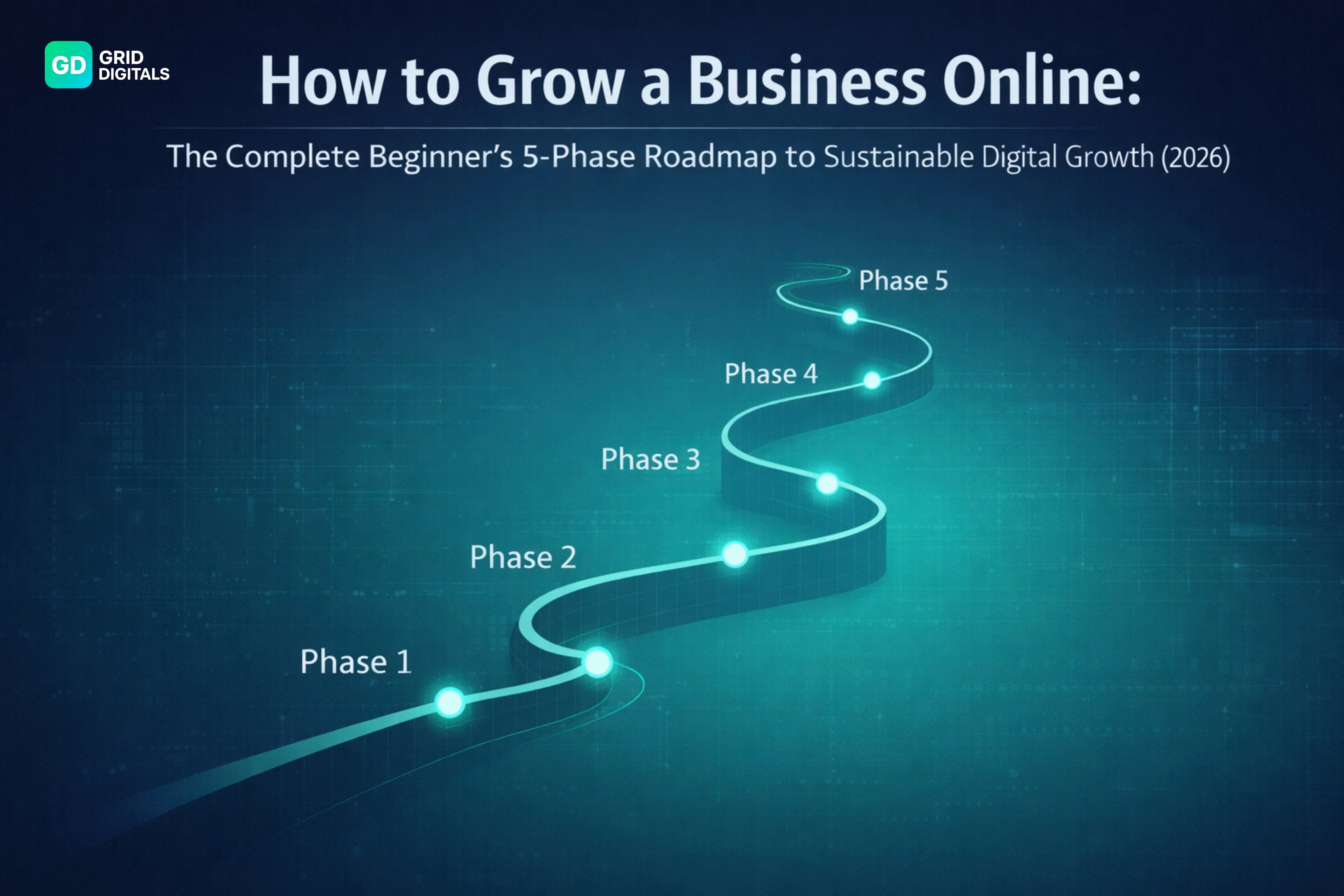
This article is the practical companion to the broader technical roadmap: Grow Your Business Online For Free: The Complete 5-Phase Roadmap to Sustainable Digital Growth .
That roadmap teaches how to:
- Build a $0 website
- Set up Google Business Profile
- Track visitors with GA4 + GSC
- Capture leads and automate email
- Connect your digital assets into one digital ecosystem strategy
But this article covers the “why behind the how” — why system connection matters and how avoiding scattered setups will save you time, money, and energy.
Part II: The Cost — The Hidden Cost of Fragmented Data and Scattered Systems
When your website, Instagram, WhatsApp, Google Business Profile, and email aren’t connected, losses stack silently in the background. This is the heavy price of a fragmented data environment.
1. Time Loss (The Silent Killer of Workforce Productivity)
You spend twice the time doing simple things because nothing “talks” to each other. Examples include:
- Customers message on Instagram, but you track orders manually in WhatsApp.
- You post on your Google Business Profile, but your website doesn’t reflect the same information → lower Google rankings.
- You reply to the same questions repeatedly because there’s no central place directing people.
This becomes a daily leak of energy — and business owners often think they’re “just busy” when they’re really disorganized. It’s disorganization disguised as hard work.
2. Money Loss (Even When Tools are ‘Free’)
Using free tools without connecting them still costs money in indirect ways. Examples include:
- You run promo posts, but your WhatsApp link isn’t connected properly → people click but don’t reach you.
- You get traffic to your website, but your contact form isn’t set up → potential customers bounce and disappear.
- You rely only on social media followers (which you don’t own) instead of capturing leads into an email list.
Every friction point = a lost customer = lost revenue. Can a connected digital system reduce operational cost? Absolutely, by eliminating these invisible leaks.
3. Lost Leads (The Biggest Hidden Cost of Fragmented Data)
Disconnected systems mean customers fall through the cracks. Examples include:
- Someone sees your business on Google, but your WhatsApp number is incorrect.
- Someone finds your Instagram page, but you didn’t link your website → they never see your services page.
- Someone visits your website, but you don’t have a clear call-to-action leading them to message you.
Leads don’t always come back. Most first-time visitors disappear forever if you don’t guide them.
Part III: The Solution — What a Truly Connected System Looks Like
A connected system doesn’t mean expensive software. It means your tools flow into each other clearly and consistently. Seamless integration is key.
What a Connected System Looks Like:
- Your Website is the Home Base: Everything links back to it — full details, services, credibility, and call-to-action live here.
- Your Google Business Profile Drives Local Traffic: Correct NAP (Name, Address, Phone) synced with your website → Google boosts your ranking → People find you faster → They can call or message you instantly.
- Social Media Channels Feed Into Your Website or WhatsApp: Instagram bio → website; X bio → website; Facebook page → WhatsApp or website; Website → WhatsApp Click-to-Chat. Social media brings attention; your website captures intent.
- WhatsApp is the Conversion Hub: Once customers message you, you convert (saved replies, product catalog, broadcast list, follow-up system).
- Email is Your Long-Term Asset: Even if your social media gets hacked or goes down, your email list still exists.
The whole system becomes: Discovery → Education → Engagement → Conversation → Conversion. Smooth. Predictable. Scalable.
Real Actionable Steps to Connect Your Assets Today
Here’s the practical “do-this-now” list — no overwhelm, no cost. Begin breaking down data silos and building an Integrated Business Technology stack:
- Fix Your Website → GBP Connection: Add your exact business name, phone number, and address to your website footer, then copy the same details into your Google Business Profile. Google rewards consistency.
- Add Your Website Link Everywhere: Instagram bio, Facebook page, X bio, WhatsApp Business profile, Email signature. Your website should appear wherever your name appears.
- Add a Strong CTA on Your Website: Example: “Chat with us on WhatsApp.” Make the button visible on your homepage and contact page.
- Link WhatsApp/any media Click-to-Chat Across Assets: Add your Click-to-Chat link on social pages, Google Business Profile, and your website’s header or footer.
- Sync Branding Across All Platforms: Use the same business name, logo, service description, phone number, and opening hours. Consistency builds trust.
- Create One Lead Capture Mechanism: Options include a Google Form on your website, a newsletter signup, or a WhatsApp lead magnet.
- Add Tracking (So Nothing Gets Lost): Google Analytics for your website, UTM links for social media, WhatsApp Business insights. Even simple tracking shows you what’s working.
Part IV: The System Ownership — Tasks Freelancer vs. Connected Digital Team
The Difference Between One-Off Freelancers and a Digital Growth Team (and why it matters for building a connected system)
Most small businesses don’t realize this early enough: Your digital growth isn’t about doing individual tasks — it’s about creating a system. This explains why a connected digital system is far more efficient than scattered digital tools.
1. Freelancers Usually Deliver Tasks, Not Systems
A freelancer’s job often ends at completing one task — building a website, creating a logo, running an ad, etc. They finish the task → send the files → collect payment → disappear.
- ❌ No documentation
- ❌ No long-term plan
- ❌ May not align with your other platforms
- ❌ No ownership of growth
2. A Digital Team Builds a Connected System, Not Just Assets
A proper digital team behaves differently. Instead of dropping tasks, they create continuity and manage your integrated business solutions.
- ✔ Maintain a primary record for your business: This is the foundation of a Single Source of Truth for your brand assets, logins, and strategy documents.
- ✔ Think in systems, not tasks: A connected team ensures that your website talks to WhatsApp, your GBP matches your site, and analytics tracks every traffic source.
- ✔ Unify branding and messaging: One unified look, tone, and experience instead of 5 different ones.
- ✔ Provide long-term digital direction: They consider how every task contributes to your full digital growth.
- ✔ Reduce owner stress: The team organizes assets, keeps history, and maintains the quality of your entire digital ecosystem.
Freelancers deliver tasks. A digital team builds a system. One disappears after sending files. The other builds, connects, documents, and grows your entire digital presence.
Part V: The Real-Life Proof — Why a Connected Team Wins
A Painfully Real Example (That Quietly Shows Why a Connected Team Wins)
Meet Amina, a fashion entrepreneur in Lagos. She built her online presence using the “cheapest and quickest” method: different people for her website, WhatsApp automation, logo, ads, and Instagram.
Everything looked fine — until the day a customer complained about a broken link and missing order confirmation.
She went to the website guy — he blamed the WhatsApp freelancer.
She went to the WhatsApp freelancer — he blamed the website person.
She asked the ads freelancer — he blamed the designer.
Everyone had done their job. But nobody owned the system.
During those 3 days of confusion: her ads kept running, customers kept clicking a broken link, she lost potential revenue, and her brand looked disorganized. This is how a scattered digital presence fails — silently, painfully, and expensively.
Now Compare It with a Connected System
If Amina had a team—even if she paid bit-by-bit for services—here’s the difference:
- One team would manage her brand assets.
- One team would control all her links.
- One team would fix any issue instantly because they built the integrated business technology together.
She would simply say: “My link is not working, please fix it.” And the team would solve it immediately. No panic. No confusion. No scattered responsibility. Just growth.
The Painful Realization Most Business Owners Eventually Reach:
Cheap is expensive when nobody owns the system. But affordable becomes powerful when one team owns everything and maintains your unified digital platform.
Conclusion: The Path to Predictive Growth
The Final Word: Achieving Real-Time Insights
The difference between Tunde and Amina’s chaotic experiences and the smooth operations of companies like Amazon is not the size of the budget; it is the design of the system. A connected digital system is more than just linked software; it’s a commitment to operational efficiency, data integrity, and a better customer journey. It replaces frantic reaction with predictive growth.
By implementing the steps outlined in this article, you stop being a project manager coordinating scattered parts, and start becoming a true business leader who relies on real-time insights from a single, unified digital platform.
The question is no longer if a connected system beats a scattered one. The only question left is: When will you stop the chaos and start connecting your assets?
Frequently Asked Questions (FAQ) — Integrated Business Technology
Answers to common questions business leaders face about connected digital systems.
Why is a connected digital system more efficient than scattered digital tools?
A connected digital system is more efficient because it creates a Single Source of Truth, eliminating manual data entry and preventing the time loss that comes from coordinating scattered software and fragmented data. It streamlines processes, boosts workforce productivity, and removes system friction that drains your team's energy.
What are the benefits of using an integrated digital platform over separate apps?
The primary benefits include operational efficiency, real-time insights for faster decision-making, increased workforce productivity, and an enhanced customer experience through seamless integration across all business functions. It allows your business to scale predictably.
Can a connected digital system reduce operational cost?
Yes. A connected digital system significantly reduces operational costs by eliminating hidden expenses like time wasted on manual fixes, lost leads due to broken links, and errors caused by data silos. Affordable system management always beats the high cost of digital chaos that results from managing disconnected tools.